

Commodities Explained: Gold, Oil, and the No-Yield Diversifier
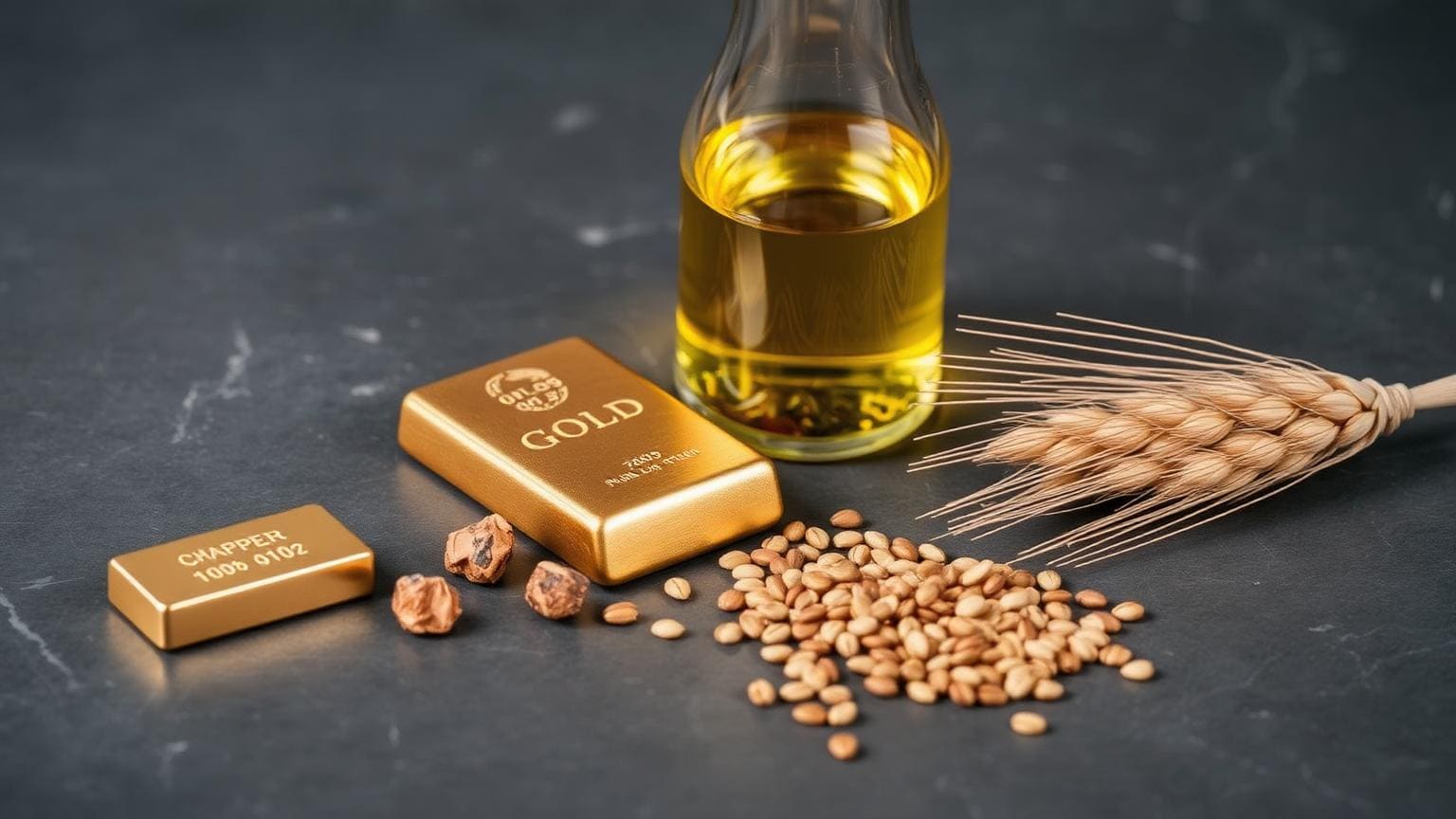
Commodities are the odd one out among asset classes. A share represents a productive business, a bond a stream of interest, a property a flow of rent, each generates income and, in theory, grows in value because it produces something. A bar of gold produces nothing. An ounce today is an ounce in a decade, paying no dividend, no coupon, no rent. So why do serious investors hold commodities at all? The answer reveals something important about what asset classes are for, and it is not always about income or growth.
The basics
Commodities are raw physical goods, the basic inputs of the economy, that are interchangeable regardless of who produces them. They fall into broad groups:
- Precious metals: gold, silver, platinum, valued partly as stores of value, partly for industrial use.
- Energy: crude oil, natural gas, the fuel of the global economy.
- Industrial metals: copper, aluminium, used in construction and manufacturing.
- Agricultural ("softs"): wheat, corn, coffee, sugar, livestock.
Their defining feature as an asset class is that they produce no income. Your entire return comes from the price changing. This makes commodities fundamentally speculative in a way that income-producing assets are not: with no cash flow to anchor a valuation, the price is whatever supply and demand decide on the day.
So the case for commodities is not income or compounding growth. It rests on two other properties:
- Diversification: commodity prices are driven by different forces (weather, geopolitics, supply shocks, industrial demand) than shares and bonds, so they often move out of step with them, the correlation benefit from the first article.
- Inflation protection: because commodities are the raw materials whose prices feed into inflation, they often rise when inflation rises, sometimes sharply, when financial assets are struggling.
Going deeper
Gold is its own category. Among commodities, gold plays a special role. It has been a store of value for millennia, is no one's liability (unlike cash or bonds, which depend on an issuer), and tends to attract buyers during crises, currency fears, and high inflation, earning its reputation as a "safe haven." Investors hold gold not to grow wealth but to preserve it and to hold something that may rise when almost everything else falls. Its critics note, correctly, that it generates no income and can go decades without gaining in real terms; its defenders value precisely its independence from the financial system. Both are right; gold is insurance, not an engine.
The futures trap: why your commodity ETF may not track the price. This is the single most important practical point, and it echoes a warning from the ETF series. You cannot easily store a tanker of oil or a silo of wheat, so most commodity investments (outside physically held gold) gain exposure through futures contracts, agreements to buy at a set price on a future date. As each contract nears expiry, the fund must "roll" it, selling the expiring contract and buying a later-dated one. When later-dated contracts cost more than near ones, a common situation called contango, this rolling steadily bleeds value. The result: a commodity fund can lag the headline spot price badly, even fall over years while the commodity itself is broadly flat. Many first-time commodity investors are baffled when their oil fund underperforms the oil price; contango is usually the culprit.
How to actually hold commodities. For most non-US investors the practical routes are exchange-traded products:
- Physically backed gold ETPs hold real bullion in a vault, the cleanest exposure, with no futures roll cost. This is how most investors hold gold.
- Futures-based commodity ETPs cover oil, broad baskets, and goods that cannot be vaulted, and they carry the roll-cost issue above.
- Commodity-producer equities (mining and energy companies) are an indirect route, but note these are equities, they behave partly like the stock market, not purely like the commodity.
Each route gives different exposure, and the differences are not subtle. Knowing which you hold is essential.
Volatility and the absence of an anchor. Because commodities have no income to value them against, prices can be extraordinarily volatile, driven by a drought, a war, an OPEC decision, or a demand collapse. They can spike and crash far more violently than diversified equities. This is why commodities are typically a small portfolio allocation, a diversifier and hedge rather than a core holding. A little can smooth a portfolio and protect against inflation shocks; a lot simply adds volatility without the long-run compounding that income-producing assets provide.
A 2026 note. Commodities have a habit of surprising. In periods of geopolitical tension and supply disruption, energy and precious metals can be among the strongest-performing assets even as equities and bonds struggle, exactly the out-of-step behaviour that makes them a diversifier. The lesson is not to chase whatever has just spiked, but to understand why commodities can shine precisely when the rest of a portfolio is under pressure.
Common mistakes
- Expecting income or compounding. Commodities pay nothing and do not compound like a business. Their entire return is price change, which makes them a diversifier and hedge, not a growth engine.
- Buying a futures-based fund expecting it to track spot. Contango and roll costs can cause a commodity ETP to lag, or fall below, the headline price over time. Always check how the fund gains exposure.
- Over-allocating. Their volatility and lack of income mean commodities suit a small allocation. A large position adds risk without long-term compounding.
- Confusing miners with metals. Mining and energy shares are equities that behave partly like the stock market, not pure commodity exposure. They are a different bet.
- Treating gold as a growth asset. Gold preserves value and may rise in crises, but it can stagnate in real terms for long stretches. It is portfolio insurance, not an engine of returns.
FAQ
Why hold commodities if they pay no income? For diversification and inflation protection. Commodity prices are driven by different forces than shares and bonds, so they often move independently, and they tend to rise with inflation, helping when financial assets struggle.
Is gold a good investment? Gold is best understood as a store of value and a crisis hedge rather than a growth investment. It pays no income and can stagnate for years, but it is independent of the financial system and often rises when other assets fall.
Why doesn't my oil ETF match the oil price? Because most oil funds hold futures, not physical oil, and must roll contracts as they expire. In a contango market, rolling erodes returns, causing the fund to lag the spot oil price over time.
How much of a portfolio should be in commodities? There is no single answer, but because they pay no income and are highly volatile, commodities typically feature as a small diversifying allocation rather than a core holding.

The takeaway
Commodities break the usual logic of asset classes: they produce no income and do not compound, so their value to a portfolio is not growth but behaviour, moving out of step with shares and bonds and tending to rise when inflation bites. Gold stands apart as financial insurance rather than an engine. The crucial practical trap is the futures roll: outside physically backed gold, a commodity fund may track its target far less faithfully than you expect. Held in modest size and with eyes open, commodities can steady a portfolio; mistaken for a growth asset, they disappoint. Next, we open the broad and often opaque world of alternatives.
Educational not advice
This article is for general educational purposes only and is not financial or investment advice, and it does not consider your circumstances. Commodity prices are highly volatile and can fall sharply. Past behaviour does not predict future results. Consider advice from a regulated professional before investing.
Sources
- World Gold Council, on gold's role as a store of value and diversifier
- Morningstar, research on commodity futures, contango, and roll yield
- Bloomberg and S&P GSCI, commodity index methodology
- Academic literature on commodities, inflation, and portfolio diversification